Taiho Jutsu is a synthesis of several Japanese martial arts, assembled for law enforcement officers. Hence, there are both techniques common to other martial arts and very specific techniques, as well as a distinctive philosophy that holds the whole thing together. It is an efficient self-defense system, used by the Japanese metropolitan police.
What it borrows
We practise Karate atemi (strikes), Judo throws, Aikido joint locks and Ju-Jitsu ground techniques. On top of those come techniques specific to the system: ground immobilisation for handcuffing purposes, use of the police stick (tambo), escorting and control techniques, and rescuing a person in danger.
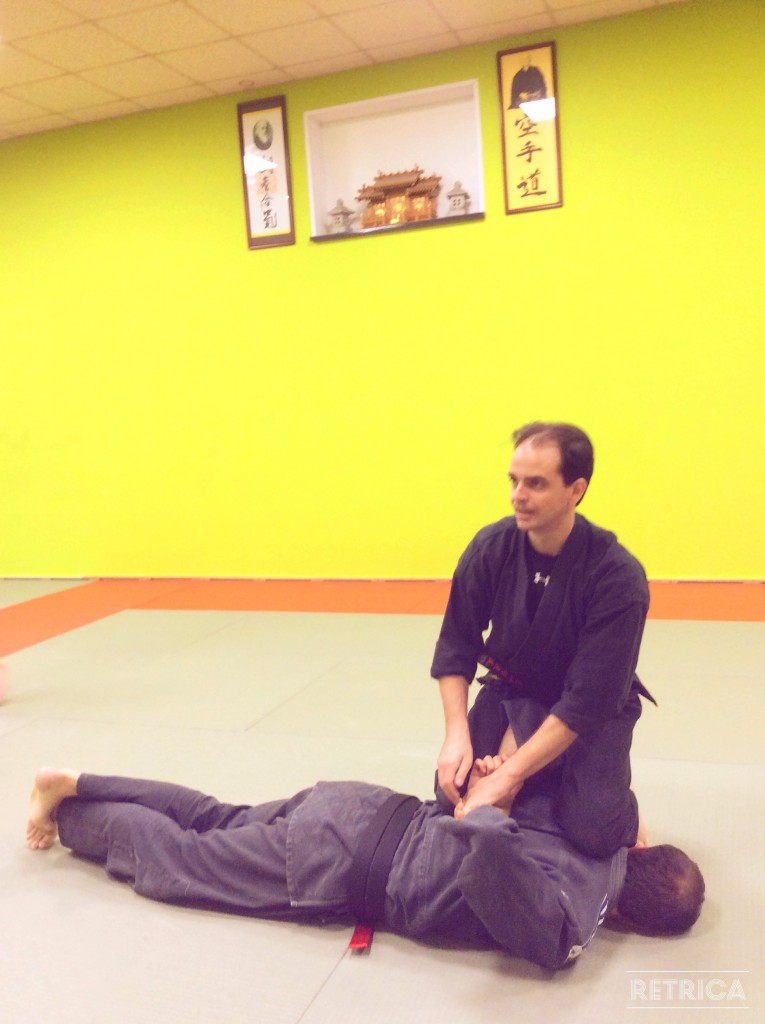
All these techniques are studied and coordinated in order to obtain maximum efficiency in the control of the opponent while respecting his health. They are not a collection of moves picked from different arts. They were selected, and continue to be selected, to work together.
See the full list of techniques →
The legal frame is part of the art
Taiho Jutsu is practised under strict respect of the rules of self-defense, and those rules are taught to the students. Every practitioner is expected to know the legislation in order to apply it in everyday life. A technique that lands you in court is not a technique that worked.
Practising self-defense should give the student real self-confidence and a relaxed state of mind, the two things that allow you to make the right decision at the right moment in a stressful situation. That is the real product of the training, and the techniques are the way to get there.
It evolves on purpose
One of the strengths of Taiho Jutsu is its ability to evolve. The system is revised at regular intervals in order to take into account the statistics of real police interventions. By listing the injuries and problems that occurred during actual operations, the system is perfected, freed of techniques that are not efficient enough and enriched with new practices.
In other words, what you learn in class is not a museum piece. It is the current best answer to a question people still face in the street.